



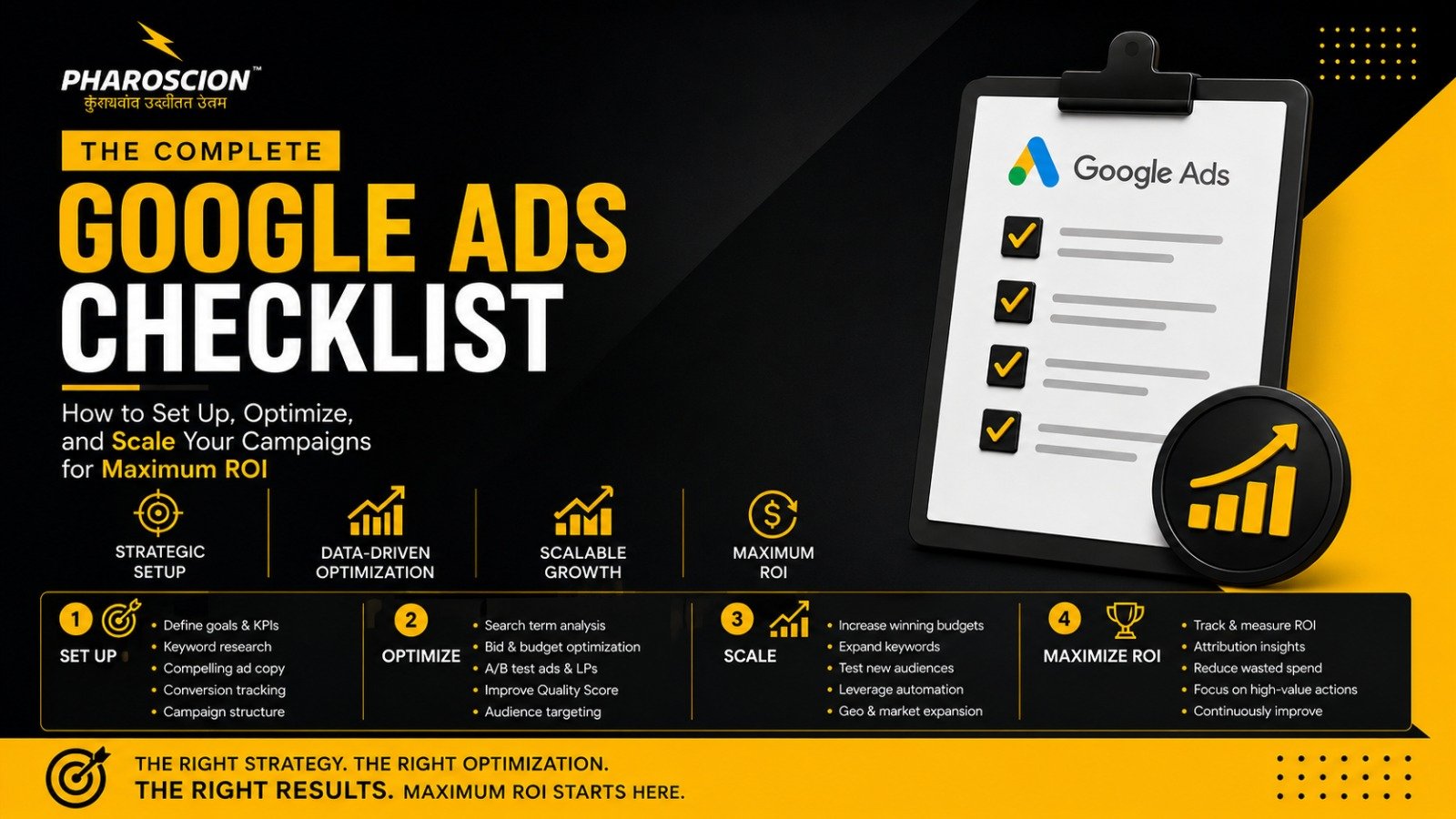
Introduction: Stop Guessing, Start Growing
Running Google Ads without a structured checklist
is like navigating a new city without GPS you might eventually get there, but you'll
waste a lot of time and money along the way.
At Pharoscion Global, we've helped
businesses across industries build Google Ads campaigns that actually convert.
Whether you're launching your very first campaign or optimising an existing one
that's underperforming, this complete Google Ads checklist will walk you
through every critical step from initial setup to scaling for maximum return.
Bookmark this post. Share it with your team. Use it
every time you launch a new campaign.
1. Google Ads Account Setup: Build a Solid Foundation
Before You Spend a Penny
Every successful Google Ads campaign begins long
before the first click. Skipping setup steps is the number one reason campaigns
fail to deliver results.
- Create
a Google Ads account or link an existing one
- Install
conversion tracking via Google Tag or GTM
- Link
Google Ads with Google Analytics
- Set
up billing and define a realistic monthly budget
- Define
your primary conversion goal: purchase, lead, or call
- Set
geographic and language targeting
- Choose
your bidding strategy start with Max Conversions or Manual CPC
Example: A
Dubai-based real estate company sets up conversion tracking to measure every
enquiry form submission and phone call. Within two weeks, they discover that
80% of their conversions come from mobile users in the evening allowing them to
shift budget and timing accordingly.
2. Google Ads Account Structure: Organise for Performance
and Scale
A well-structured account makes optimisation
easier, improves Quality Scores, and ensures your budget goes exactly where it
should.
- Create
separate campaigns for each business goal - Sales, Leads, or Traffic.
- Segment
ad groups by tight, focused keyword themes.
- Use
clear naming conventions, for example, Brand_Search_AE.
- Separate
Brand vs Non Brand campaigns.
- Focus
each ad group on one product or service.
- Add
negative keyword lists from day one.
Example: An e commerce
store selling shoes separates its campaigns into Running Shoes, Formal Shoes,
and Kids Shoes. Each has its own ad groups, budgets, and messaging - making it
easy to see exactly which category is profitable and which needs work.
3. Google Ads Keyword Strategy: Target the Right People at
the Right Moment
Keywords are the backbone of Search campaigns. A
smart keyword strategy means showing up when it matters most and staying
invisible when it doesn't.
- Use
Google Keyword Planner to find relevant keywords.
- Prioritise
high-intent keywords: "buy", "hire", "near
me", "best price".
- Apply
match types correctly - Exact for precision, Phrase for balance, Broad
with caution.
- Add
relevant keyword variations per campaign.
- Continuously
grow your negative keyword list.
Example: A law
firm targeting clients for business setup services adds "how to register a
company" as a negative keyword. This prevents their budget from being
spent on people doing research rather than people ready to hire immediately
improving their conversion rate.
4. Writing Google Ads Copy That Converts: Speak to Intent,
Not Just Features.
Your ad is your first impression. In a few short
characters, it needs to stop the scroll, communicate value, and earn the click.
- Write
headlines that combine benefits with keywords.
- Include
your primary keyword in at least one headline.
- Use
emotional, outcome driven language.
- Add
a strong, specific CTA: "Get a Free Quote", "Book
Today", "Claim Your Offer".
- Test
2–3 ad variations per ad group.
- Use
all available assets like Sitelinks, Callouts, Structured Snippets.
- Highlight
your USP: price, speed, guarantee, or unique value.
Example: Instead
of writing "Accounting Services in Dubai", a firm rewrites their
headline as "Save 20% on Tax This Year - Book a Free Consultation
Today." The second version speaks directly to the outcome the customer
wants, resulting in a higher CTR and more qualified leads.
5. Optimising Landing Pages for Google Ads: Where Clicks
Become Customers
A great ad that leads to a poor landing page is
wasted money. Your ad and your landing page must work together as one seamless
experience.
- Match
your landing page message to your ad 1:1 relevance.
- Keep
page load speed under 3 seconds.
- Place
a clear headline and offer above the fold.
- Make
your CTA button immediately visible.
- Fully
optimise for mobile.
- Include
trust signals: reviews, testimonials, and badges.
- Ensure
conversion tracking fires correctly on every action.
Example: A
fitness studio running ads for a "Free First Class" offer sends
traffic to their homepage instead of a dedicated landing page. After creating a
focused page that mirrors the ad's message with a single sign-up form, their
conversion rate triples overnight.
6. Google Ads Integrations and Tools: Connect Your
Ecosystem for Smarter Data
The more connected your tools, the smarter your
decisions. These integrations give Google's algorithm the data it needs to
optimise on your behalf.
- Link
Google Tag Manager.
- Connect
Google Analytics 4 for behavioural insights.
- Integrate
your CRM - HubSpot, Salesforce, or equivalent.
- Set
up call tracking if phone leads are important to your business.
- Enable
Enhanced Conversions.
- Import
offline conversions where applicable.
Example: A B2B
software company connects their CRM to Google Ads and imports offline
conversion data showing which leads actually closed into paying customers.
Google's algorithm then automatically shifts budget toward the keyword segments
generating real revenue not just form fills.
7. Google Ads Optimisation: How to Continuously Improve
Campaign Performance
Launching a campaign is just the beginning.
Consistent, data-driven optimisation is what separates profitable accounts from
money pits.
- Review
the Search Terms Report weekly.
- Pause
keywords with high spend and low conversions.
- Increase
bids on high-converting keywords.
- A/B
test ad copy continuously.
- Optimise
Quality Score improve CTR, relevance, and landing page experience.
- Adjust
bids by device, location, and time of day.
- Test
different bidding strategies as your data grows.
Example: After
reviewing their Search Terms Report, a home renovation company discovers their
ads are showing for "DIY kitchen ideas" people looking to do it
themselves, not hire someone. Adding this as a negative keyword reduces wasted
spend by 30% in the first month.
8. Google Ads Campaign Management: Scale What Works, Cut
What Doesn't
Smart campaign management means being decisive,
doubling down on winners and cutting losers before they drain your budget.
- Create
one campaign per objective.
- Separate
cold audiences from warm audiences and remarketing.
- Use
remarketing campaigns to re-engage past visitors.
- Scale
winning campaigns gradually
increase budgets by 15-20% at a time.
- Allocate
more budget toward top performers.
- Cut
underperforming campaigns quickly and without hesitation.
Example: A travel
agency notices one campaign targeting "honeymoon packages Dubai" is
generating leads at half the cost of their other campaigns. They immediately
double its budget and pause two underperforming campaigns, resulting in the
same number of total leads at 40% less total spend.
9. Google Ads Budget and Performance Tracking: Measure
What Actually Matters
Budget management isn't just about how much you
spend, it's about where, when, and why. Every dirham or dollar should be
accountable.
- Start
small and scale based on proven ROI.
- Track
CPC, CPA, ROAS, and POAS weekly.
- Avoid
broad match on tight budgets.
- Reallocate
budget weekly based on performance data.
- Focus
on profitable conversions, not just clicks.
- Review
performance every 3-7 days.
Example: A
skincare brand tracks POAS instead of ROAS and realises that their bestselling
product despite lower revenue delivers three times the profit margin of their
promoted bundles. They shift budget toward individual product campaigns and see
overall profitability climb significantly.
10. Research and Scaling: From Profitable to Dominant
Once your foundations are solid and campaigns are
profitable, it's time to think bigger. Research backed scaling separates growth
brands from stagnant ones.
- Use
Auction Insights to benchmark against competitors.
- Identify
new keyword opportunities every week.
- Expand
into Display and YouTube when Search is stable.
- Test
Performance Max campaigns for multi-channel scaling.
- Monitor
seasonal trends and plan around peak demand.
Example: A gift
shop notices through Google Trends that searches for "corporate gifts
Dubai" spike every October ahead of the National Day season. They prepare
campaigns two weeks in advance, increase budget during peak weeks, and capture
demand their competitors miss entirely by reacting too late.
The Final Rule
Focus on value. Test. Optimise. Repeat.
Better Data → Better Decisions → Better Results
Conclusion: Your Google Ads Success Starts with a Plan
Google Ads is one of the most powerful customer
acquisition channels available today but only when executed with structure,
strategy, and a commitment to continuous improvement.
This checklist covers everything: from your very
first account setup to scaling profitable campaigns across Search, Display, and
beyond. Use it as your ongoing operational guide every time you build or review
a campaign.
At Pharoscion Global, we specialise in
building and managing high performance Google Ads campaigns for businesses that
are serious about growth. Whether you need a full account build, a thorough
audit, or ongoing management from a results driven team ,we're ready to help
you get results that move the needle.
Ready to grow with
Google Ads?
Pharoscion Global - Driving Performance. Delivering Results.
• Read our latest insights – https://www.pharoscion.com/blogs
• Access detailed research – https://www.pharoscion.com/white-papers
• Explore real-world success stories – https://www.pharoscion.com/case-studies