
We blend strategy, creativity, and technology to help brands grow, connect, and stand out in an ever-evolving digital world.




In the ever-evolving landscape of digital marketing, understanding the trajectory from Search Engine Optimization (SEO) to Generative AI Optimization (GAIO) and Generative Engine Optimization (GEO) is crucial for navigating today’s complex digital ecosystem. This journey marks a profound shift in how brands approach visibility, engagement, and relevance in an age where artificial intelligence increasingly shapes user experiences and decision-making processes.
This insight page will guide you through this transformative journey, starting with a thorough understanding of SEO, GAIO, and GEO. We will explore how each phase represents a critical evolution in digital marketing strategies, providing a comprehensive overview of their implications for brand visibility and engagement. By examining the historical context and current applications of these optimization strategies, this report will equip you with the knowledge to leverage these advancements effectively, ensuring your digital marketing efforts are aligned with the latest industry developments.
Prepare to delve into a detailed exploration of these concepts and discover how they can be strategically utilized to enhance your digital marketing initiatives in an increasingly AI-driven world.
Search Engine Optimization (SEO), the foundation of digital marketing for over a decade, was once synonymous with the quest for higher rankings on search engine results pages (SERPs). Brands meticulously crafted their strategies around keyword placement, backlink building, and content optimization to capture organic traffic and enhance their online presence. The primary focus was to ascend the ranks of search engines like Google, Bing, and Yahoo, relying heavily on well-defined tactics to improve visibility.
But this landscape, while efficient for its time, was far from perfect. The early days of SEO were marred by over-optimization and “black hat” tactics, where brands stuffed their content with keywords to manipulate search algorithms. User experience was often sacrificed, as content was created more for search engines than for actual human readers. Although SEO grew more refined with time, the rapid evolution of technology—particularly AI—has introduced more sophisticated ways to optimize not only websites but entire marketing strategies.
Enter Generative AI Optimization (GAIO), a technology that marks a turning point in how brands approach digital marketing and branding. GAIO extends beyond traditional SEO, embedding AI into every aspect of content and brand visibility optimization. Unlike SEO, which relies heavily on backlinks and keyword placement, GAIO focuses on brand mentions in AI-driven tools, such as ChatGPT, Bing Chat, and Google Bard.
In this new world, it’s not just about how many people link to your website—it’s about where and how often your brand is mentioned in AI-generated responses. Large Language Models (LLMs) like ChatGPT and Bing Chat are becoming primary sources of information for millions of users worldwide. Whether a user is asking for a product recommendation or seeking advice on software solutions, these LLMs are now influencing purchase decisions by providing personalized suggestions based on context and prior brand mentions.
Example: Imagine a user asking Bing Chat about the best ERP software for a startup. The answer might include mentions of SAP Business One or Microsoft Dynamics, not because of backlinks but because these brands have been contextually mentioned and validated in similar conversations. This is the core of GAIO: it shifts focus from keywords and links to contextual brand mentions that AI tools deem relevant for user queries.
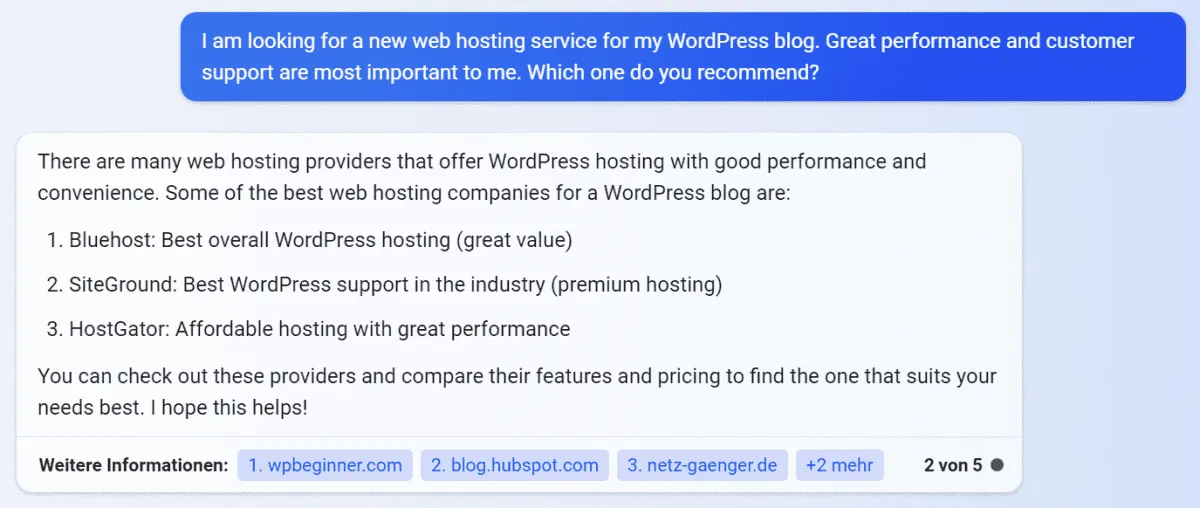
Chat Based Search
With GAIO, the rules of the game are no longer about ranking for keywords. Instead, brands need to engage AI models—ensuring that their products, services, and messages are embedded in the fabric of AI’s vast knowledge base. This involves creating a digital footprint that consistently places your brand in conversations where AI models reference trusted sources for recommendations.
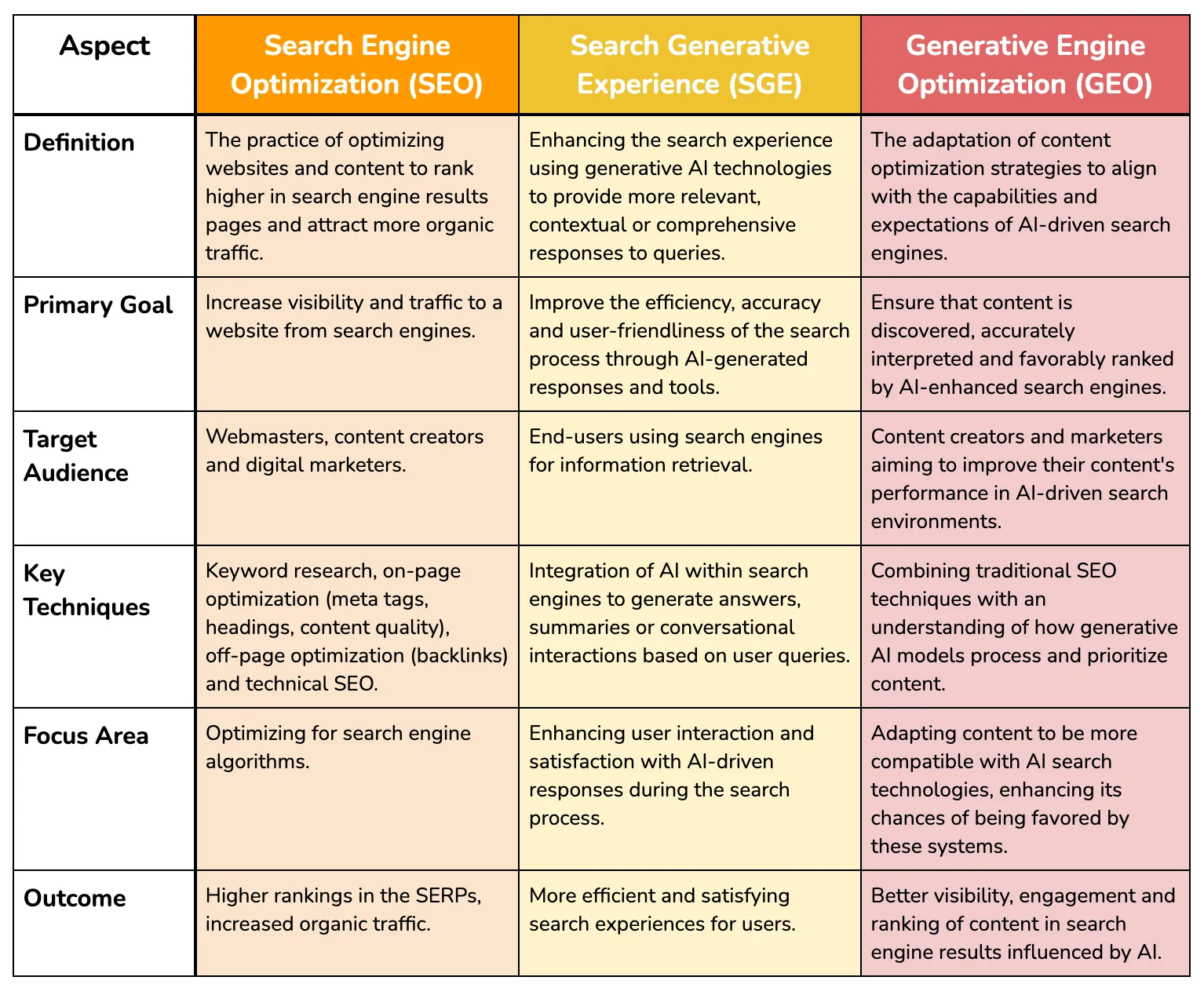
If GAIO transformed how brands gain visibility, Generative Engine Optimization (GEO) is taking it even further by focusing on optimizing content specifically for AI-driven search experiences. GEO is the next evolution in search optimization, where AI algorithms don’t just list results based on ranking factors but generate comprehensive, contextual responses to user queries.
Think of GEO as the intersection between SEO and AI-powered tools. As Google, Bing, and other search engines integrate generative AI into their results pages, the way content is ranked and displayed has evolved significantly. Gone are the days where a simple list of links would suffice. Today’s AI-powered search engines like Google’s Search Generative Experience (SGE) and Bing AI are focused on delivering AI-generated snapshots—summarizing the most relevant information based on user intent, synthesizing responses from multiple sources.
For brands, this means the traditional SEO strategies have evolved. You’re no longer fighting for just the top link—you’re striving to have your brand mentioned in the AI-generated response itself.
The shift to GAIO and GEO has had a profound impact on how companies approach digital marketing. While the SEO era focused heavily on climbing the search results ladder, the GAIO and GEO world offers richer opportunities for brand engagement and a more dynamic approach to connecting with consumers.
Example: Walmart uses AI-powered chatbots to offer personalized product suggestions in real time, leveraging GAIO principles to embed its products in AI-driven customer service platforms. This has resulted in a 15% increase in conversion rates from chatbot interactions alone.
Example: Spotify has harnessed GEO to create highly personalized content playlists, which AI models recommend to users based on their listening history. This has led to a 25% increase in user engagement, as AI understands and caters to user preferences more effectively.
While SEO will continue to play a role in digital marketing, the future belongs to GAIO and GEO. To stay competitive, brands need to integrate all three optimization strategies, ensuring that they rank well for traditional search engines, while also positioning themselves favorably within AI-driven platforms.
By embracing this hybrid approach, brands can ensure they remain visible across both traditional and AI-driven digital landscapes.
The New Bing search and Google's new Search Generative Experience (SGE) now include generative AI models in their algorithms and via conversational search modules directly on their Search Engine Results Pages (SERPs).
Google's SGE is powered by an array of advanced AI models, including LaMDA (Language Model for Dialogue Applications) and PaLM 2 (Pathways Language Model 2)—the core language models powering its conversational chat service, Bard.
Bing's new generative AI-powered search experience is available to anyone using Bing through Microsoft's Edge browser.
The new Bing runs on multiple AI models from Microsoft and OpenAI. The Bing chat module on its SERPs is powered by GPT-4, the same model behind ChatGPT.
Google and Bing have integrated generative AI into their search experiences with the primary goal of keeping users engaged on their search engine results pages (SERPs) longer, thereby increasing ad exposure and revenue. This approach involves:
For content marketing, it's crucial to aim for maximum visibility on SERPs. Despite the potential short-term impact on click-through rates (CTR) due to the new AI-driven SERP features, there are now more opportunities than ever to build brand presence.
With Google's Search Generative Experience (SGE), the top of the new search engine results page (SERP)—often referred to as "position zero"—now features an AI-generated snapshot. This element functions similarly to the traditional featured snippet but represents a significant evolution. Instead of extracting and presenting an answer from a single source, the AI-generated snapshot synthesizes information from various sources across the web. To the right of this synthesized answer, users can view the original sources from which the information was derived.
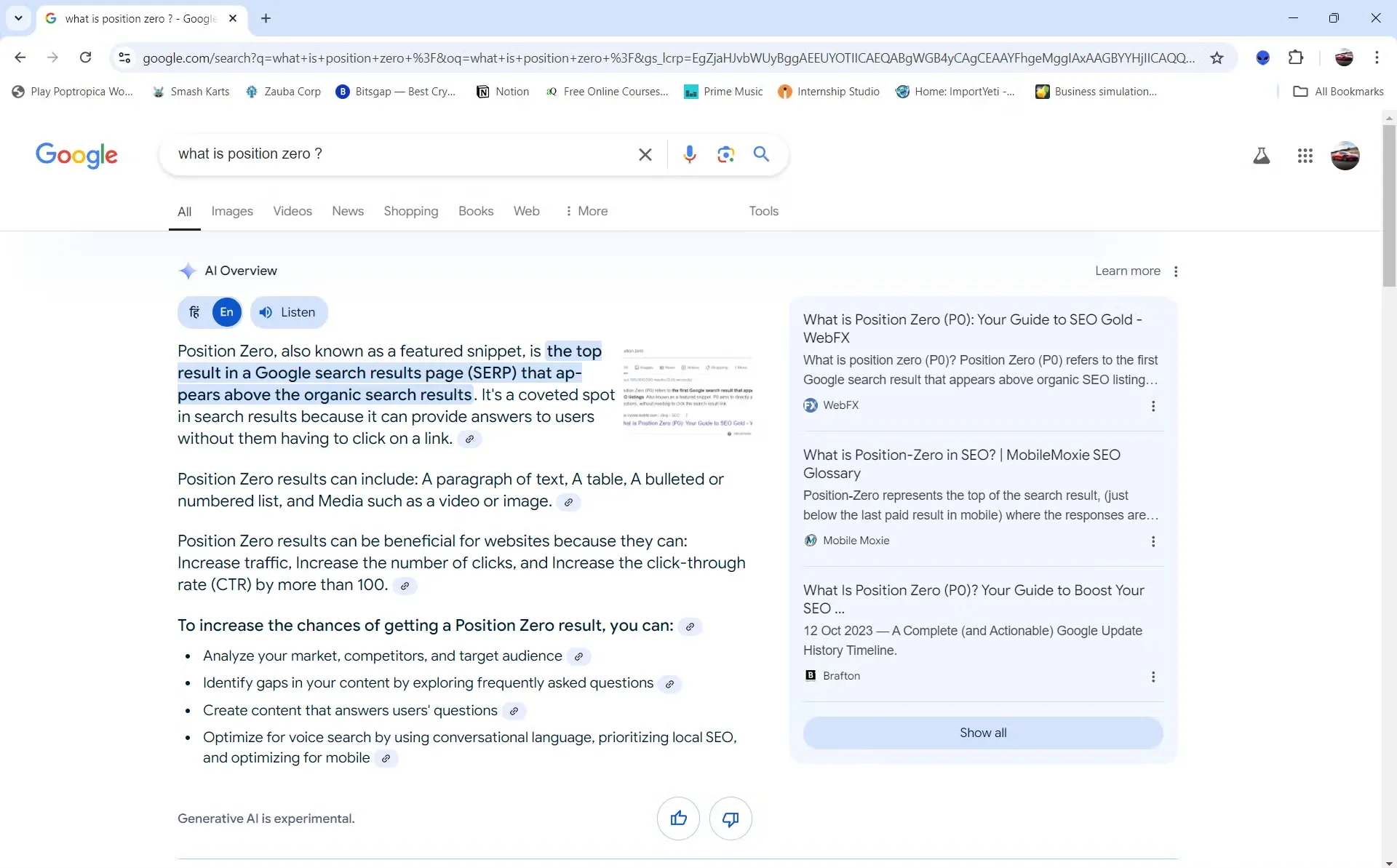
Google's SGE fills position zero with an AI-generated response, and links the response source on to the right.

The new Bing usually fills position zero with snippets from what it determines are the top answer sources.
Both Google and Bing have enhanced the area below position zero with targeted content recommendations, including related topics and next steps. This approach offers users more options and encourages extended engagement with the search platform.
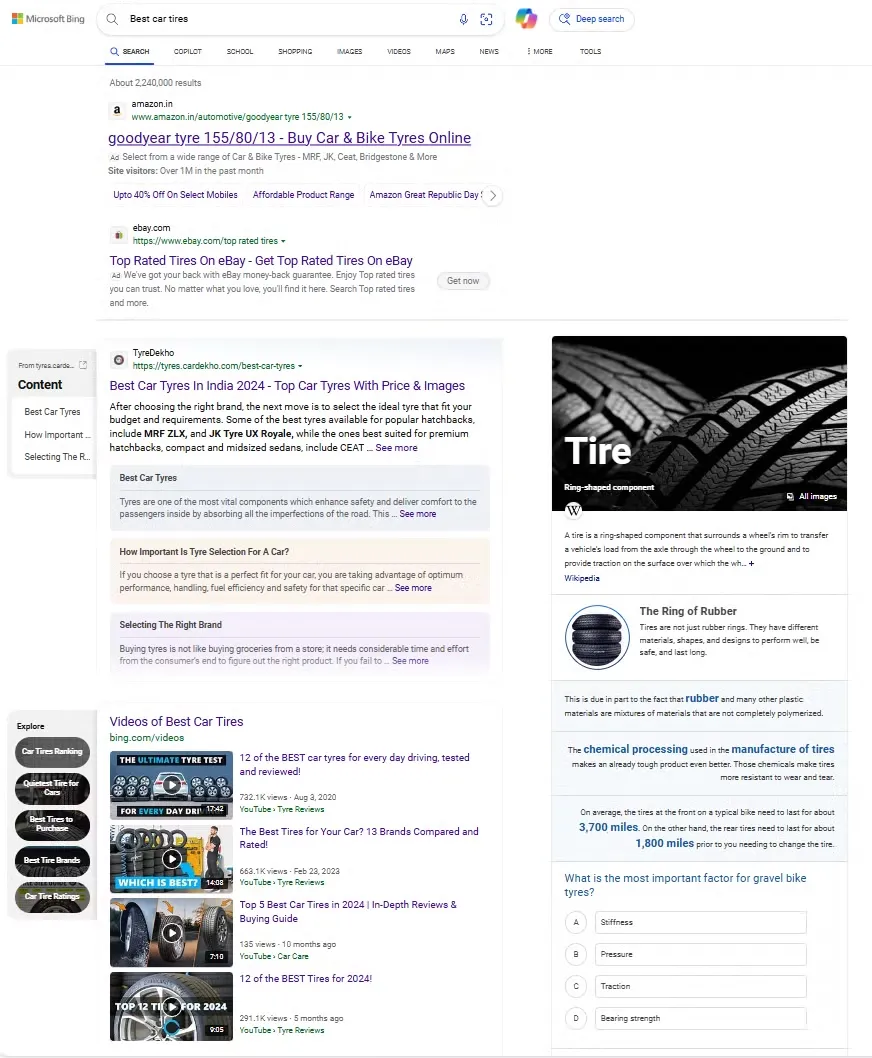
A better search experience for users offering more enticing search space for brands and marketers.
Google and Bing now offer conversational interfaces directly on their SERPs, allowing users to ask follow-up questions and receive evolving answers without needing new searches. This integrates Bard and ChatGPT-like capabilities for seamless, continuous queries.

Google's SGE allows users to chat on the SERP and ask follow-up questions.

An in-depth chat with Bing can be triggered from the copilot icon next to search bar
Generative AI represents the future of digital marketing by enhancing the speed, scale, and precision of content creation. The ability to generate text, images, and even video content through AI-driven platforms like GPT-4 and DALL-E has radically shifted traditional marketing workflows, enabling brands to create tailored, high-impact assets at scale.
Gen-AI now has become indispensable in digital marketing, offering unprecedented capabilities for personalizing content and optimizing strategies. Today, CMOs are harnessing this technology to gain a competitive edge, underscoring its critical importance in shaping the future of marketing.
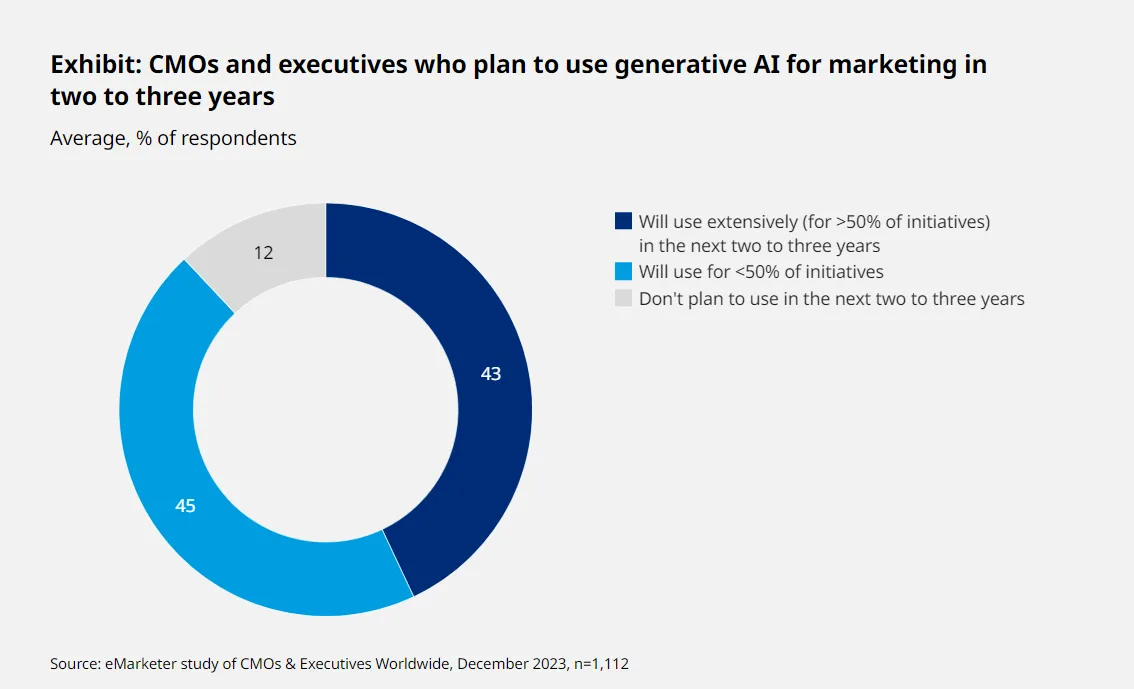
Survey asking CMOs and executives the usage of Generative AI for Digital Marketing
Strategic Impact: Brands using generative AI can streamline production, enhance campaign performance, and amplify their customer connection through tailored content designed to resonate with specific audiences.
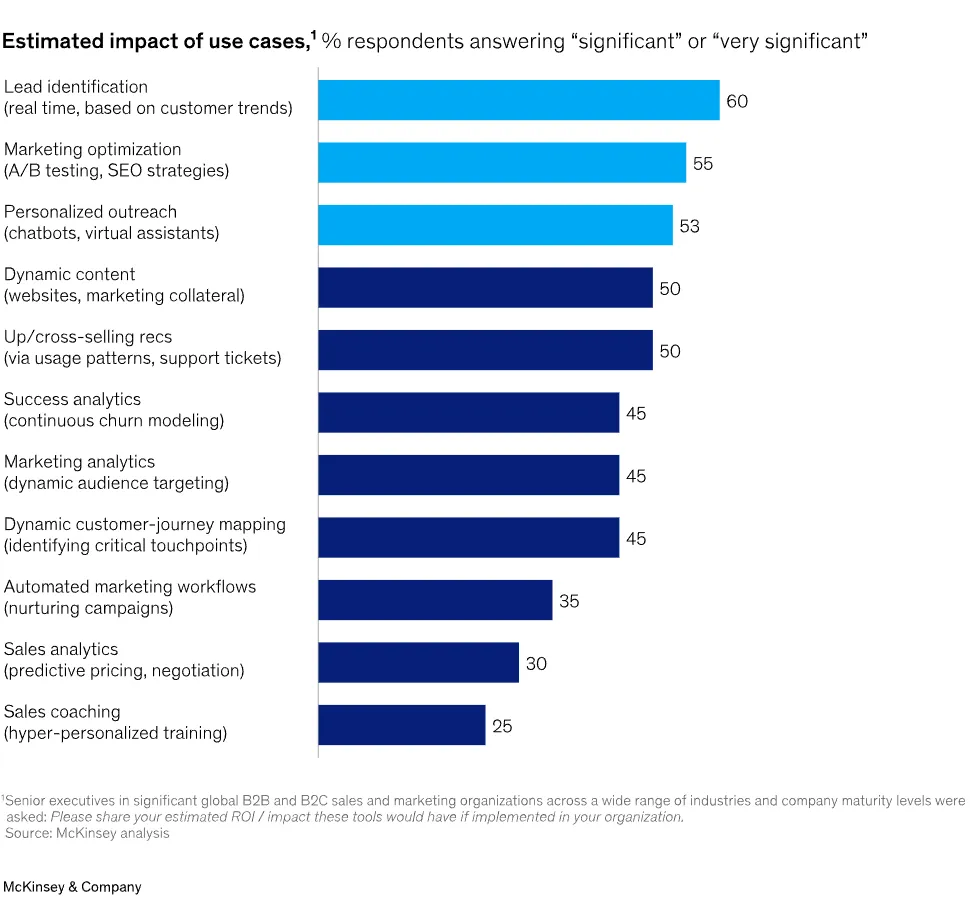
Commercial leaders are cautiously optimistic about gen AI use cases, anticipating moderate to significant impact
In digital marketing, where consumer attention is fleeting, brands must consistently deliver personalized and engaging content to stay competitive. Generative AI addresses this by integrating deeply into three main pillars:
offering a seamless, data-driven approach to brand optimization.
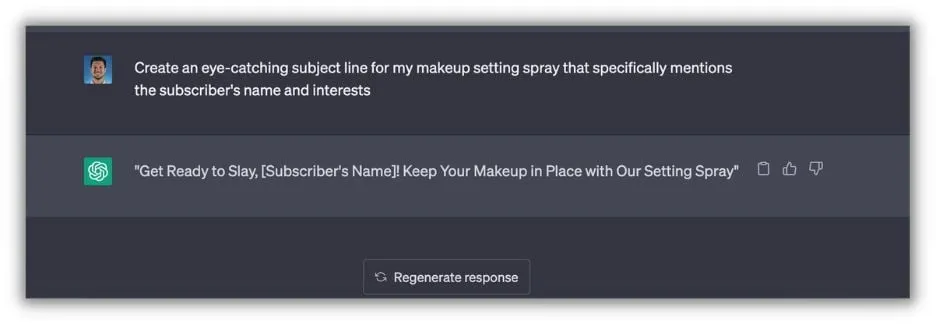
The digital age brought with it an explosion of content, with brands vying for attention in an increasingly saturated marketplace. In the early days of digital marketing, personalization meant little more than inserting a customer’s name into an email subject line or adjusting product recommendations based on recent purchases. This form of personalization was rudimentary—effective in its time, but constrained by technological limitations and the manual processes required for execution.
In traditional marketing paradigms, the content creation process was an intrinsically labor-intensive and manual endeavor, heavily dependent on the collaboration between copywriters, graphic designers, and cross-functional marketing teams. These teams were tasked with generating blog posts, crafting email campaigns, and producing social media content. The core challenge was not only to develop content that was creatively engaging but also to ensure that the messaging resonated with the intended target audiences across diverse channels.
Marketers, constrained by the limitations of demographic segmentation, often employed broad-based stratification techniques, categorizing consumers into generalized cohorts based on high-level attributes such as age, geographic location, and gender. This one-dimensional segmentation strategy aimed to cast a wide net, relying on macro-level audience insights to disseminate uniform messaging. However, this one-size-fits-all approach—though functional for mass-market campaigns—proved inefficient when addressing the complex nuances of micro-targeted niche segments.
Even as the industry began to shift toward personalized content strategies, these efforts were often siloed within specific channels. For instance, marketers could deploy personalized messaging in email marketing campaigns, utilizing basic segmentation data to adjust subject lines or offers. However, they encountered significant friction in extending these personalized experiences across a multichannel marketing ecosystem—including social media platforms, website interfaces, and real-time product recommendation engines. This operational disjointedness resulted in fragmented and inconsistent customer experiences, thereby impeding brands from fostering cohesive, omni-channel engagement with individual consumers.
Generative AI has brought about a revolution in personalized content creation, taking marketing from broad-strokes demographics to micro-segmentation at scale. With the ability to process massive datasets in real-time, generative AI can craft messages, offers, and experiences that are hyper-tailored to individual user behaviors, preferences, and interactions.
By harnessing machine learning algorithms and natural language processing (NLP), generative AI tools like GPT-4 can sift through data from multiple sources—social media interactions, browsing history, past purchases, and even sentiment analysis from reviews—to create content that feels personal, relevant, and timely. Instead of relying on generalized messaging, brands can now craft individual narratives for each consumer, creating a much deeper connection.
For example, instead of sending the same promotional email to a thousand users, AI can generate unique emails for each recipient based on their specific needs and preferences. One user might receive a product recommendation based on recent browsing history, while another receives a targeted offer based on previous purchases. These tailored experiences extend beyond email to social media posts, website copy, and even dynamic landing pages, creating a cohesive journey for each customer.
The true power of generative AI lies in its ability to scale personalization in ways previously unimaginable. While human teams would be hard-pressed to manually personalize content for every customer, AI can do so instantaneously, adjusting and optimizing content based on real-time interactions.
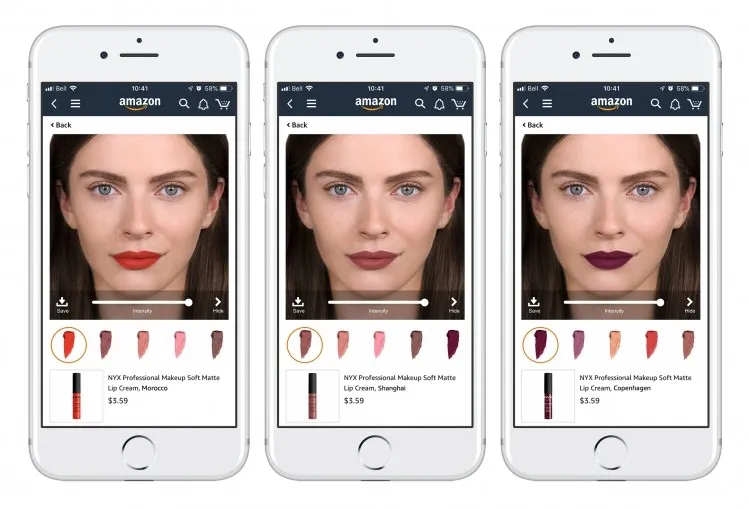
L'Oreal brings augmented reality via Modiface to Amazon - Glossy
The global beauty brand L’Oréal exemplifies the transformative power of AI-driven personalization. Leveraging AI to develop its AI Beauty Genius platform, L’Oréal offers highly personalized beauty recommendations based on individual user data. Users interact with the platform to receive custom skincare and beauty routines tailored specifically to their skin type, concerns, and preferences. Through generative AI, L’Oréal delivers targeted content at every touchpoint, resulting in:
This AI-driven platform showcases how hyper-personalization can move beyond mere product suggestions to create a holistic, individualized customer journey.
The rise of generative AI has transformed personalized content from a nice-to-have into a business imperative, driving significant benefits:
As brands continue to adopt generative AI for personalized content creation, those that embrace these technologies early will be best positioned to connect with the modern consumer—who increasingly expects customized, relevant, and seamless experiences.
In the pre-AI world, creating effective ad campaigns was an art form reliant on teams of copywriters, designers, and creative directors working together to craft compelling visuals and copy that would resonate with target audiences. Each campaign was the product of hours of manual labor, with marketers iterating and fine-tuning ads based on audience feedback and performance metrics.
However, the creative process had inherent limitations. Brands could only run a few ad variations at a time, and A/B testing took weeks or even months to identify which ad performed best. This lack of flexibility and agility often led to missed opportunities to optimize campaigns in real-time, resulting in lower engagement rates and inefficient ad spend.
Generative AI has completely upended the traditional model of ad design, allowing brands to produce dynamic, highly personalized ad creatives that adjust in real-time based on performance data. Generative AI platforms can now generate visuals, video content, and ad copy almost instantaneously, empowering brands to run thousands of ad variations at once—each tailored to a specific segment of the audience.
By analyzing past performance data, AI models can predict which ad elements—such as imagery, color schemes, or copy—are most likely to resonate with different demographics. The result is a data-driven creative process where ads are continuously optimized to improve engagement and conversion rates.
At the heart of AI-powered ad design is the ability to generate multivariate ad creatives in real-time. Unlike traditional A/B testing, which compares two versions of an ad, AI allows for multivariate testing at scale. This means that brands can test hundreds of ad variations simultaneously, optimizing for every possible combination of copy, visuals, and audience segments.
AI automates the creation and testing of ads, pulling data from previous campaigns, analyzing engagement patterns, and adjusting ad elements based on real-time performance feedback. This creates a feedback loop where AI continuously refines ad creatives to maximize their effectiveness.
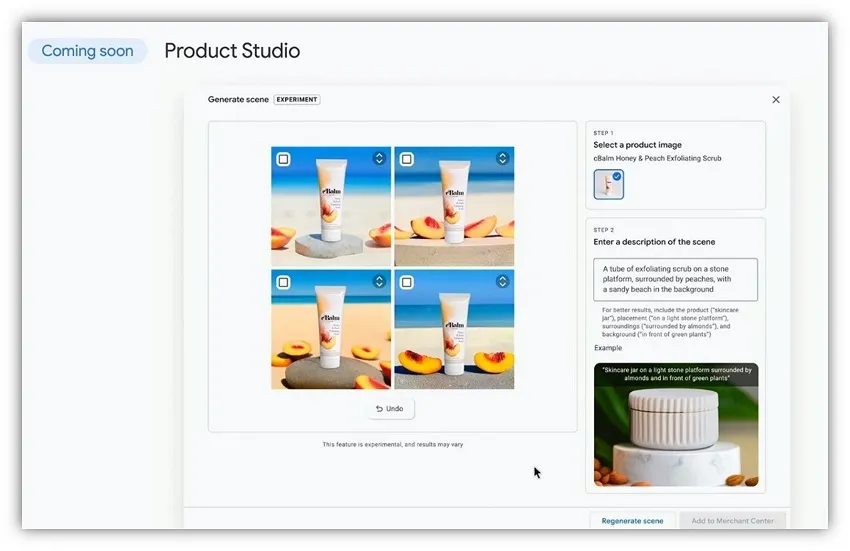
Product Studio, announced at Google Marketing Live 2023, uses AI to generate product images.
A prime example of generative AI in action is BMW’s use of AI-driven ad personalization. For a recent campaign, BMW leveraged AI tools to design over 100 ad variations, each tailored to a specific car model and target demographic. By using AI to analyze consumer data and identify the most effective combinations of visuals and copy, BMW optimized their ad performance in real-time, resulting in:
By automating the ad design process, BMW reduced the time spent on manual creative work while simultaneously improving engagement and conversion rates.
According to a SurveyMonkey study, 72% of marketers believe AI-generated images will be very useful for creating ads, social posts, and other visual assets. As the technology keeps advancing, adoption will continue growing.
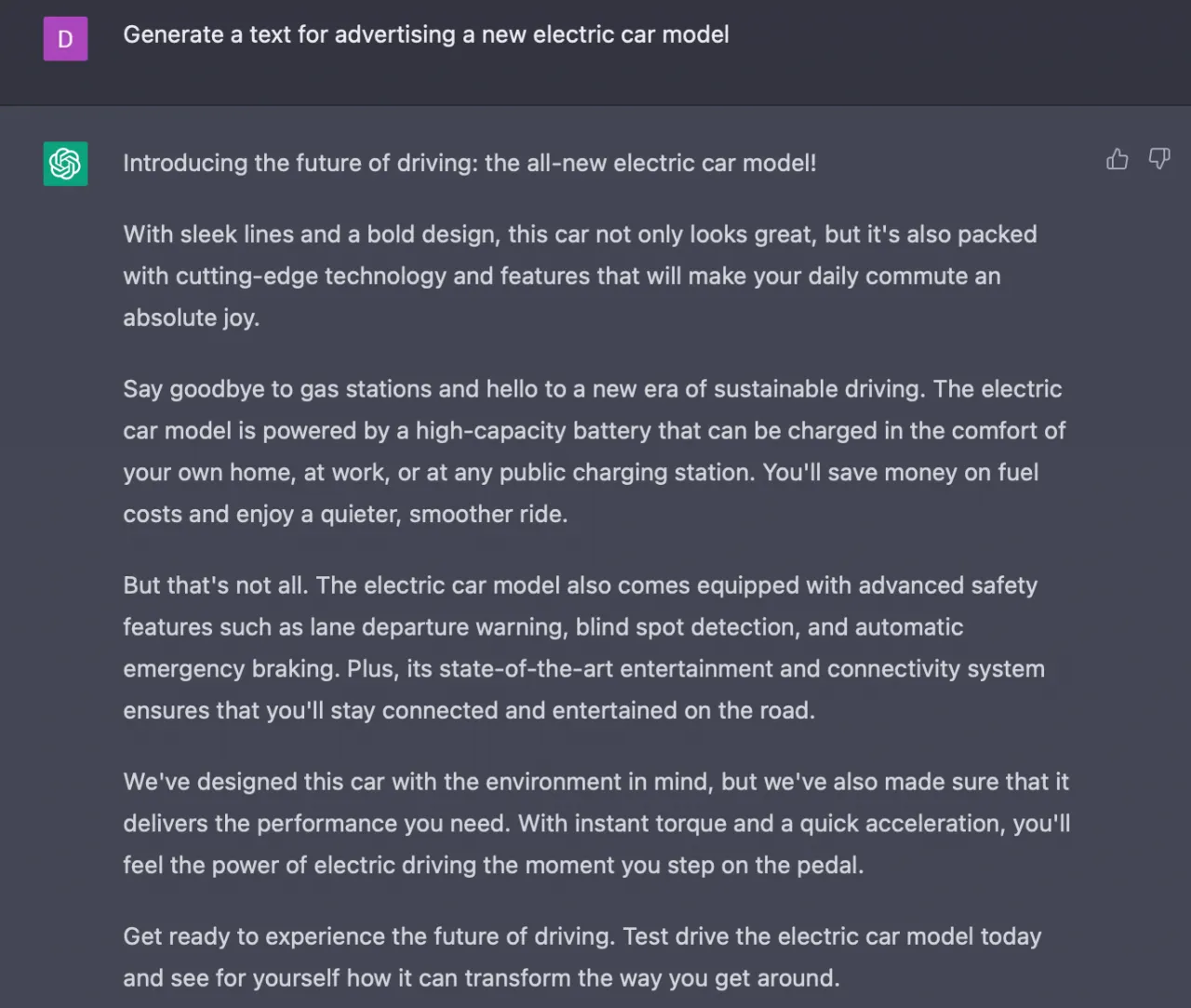
Generative AI’s ability to automate and optimize ad design delivers significant strategic advantages to brands seeking to enhance their digital marketing performance:
In the early years of digital marketing, brand storytelling was an exercise in human creativity. Teams of writers, marketers, and strategists would gather to craft narratives designed to resonate with their audience, relying on intuition, focus groups, and historical data. The process, while powerful, was limited by its subjective nature and the inability to dynamically adapt to real-time consumer preferences.
Before the rise of AI, storytelling relied on creating a single narrative for all audiences, hoping to strike a chord with as many people as possible. This method often led to generic brand messaging, which lacked personalization and failed to truly engage different consumer segments. Marketers had to balance creativity with logistical constraints, as producing tailored stories for different groups was costly and time-consuming.
Generative AI has revolutionized brand storytelling by offering the ability to create dynamic, personalized narratives at scale. By leveraging Natural Language Processing (NLP) and machine learning algorithms, brands can craft stories that are not only data-driven but also continuously evolving based on real-time consumer behavior, market trends, and emotional cues.
No longer is storytelling a static exercise. With AI, stories can now shift and adapt in real-time, reflecting the unique interests and behaviors of individual consumers. AI models analyze vast amounts of data, including sentiment analysis, customer feedback, and purchase history, to craft emotionally resonant stories that feel personal and relevant.
Generative AI enables brands to create dynamic, multi-channel narratives that adjust in real-time based on user interactions. The process is continuous: as customers engage with content, AI learns from those interactions, refining the brand narrative to better suit their needs and preferences. This results in storylines that evolve throughout the customer journey, making each interaction feel uniquely tailored to the individual.
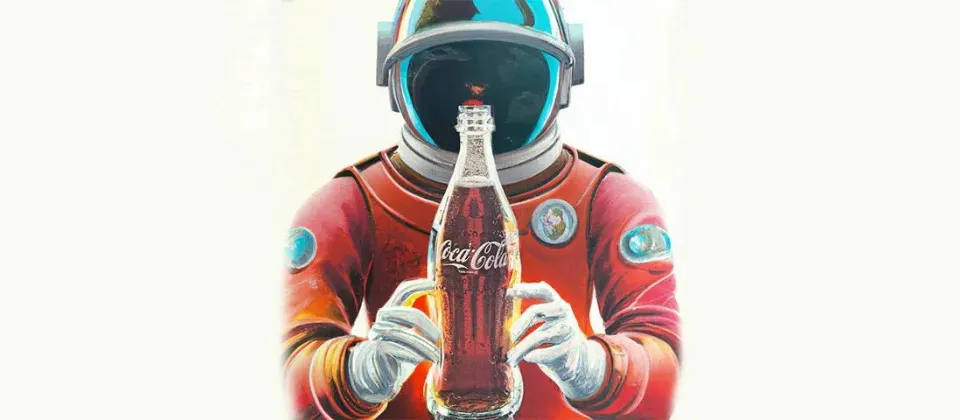
Coca-Cola’s Create Real Magic campaign is a perfect example of how AI-powered storytelling can transform brand engagement. By using AI tools such as DALL-E and GPT-4, Coca-Cola invited consumers to become co-creators, allowing them to generate personalized artwork using Coca-Cola brand assets. This not only democratized the storytelling process but also fostered a deeper connection with consumers, as they became an integral part of the brand’s narrative.
The campaign’s results were significant:
The integration of generative AI into brand storytelling offers profound benefits for marketers looking to build stronger emotional connections with their audiences:

Churn rate reduction: It’s five times more expensive to win over new customers than to retain existing ones. Brands can use advanced language models to understand and address customer churn. By analyzing reasons for customer disengagement and identifying potential risks, they can proactively respond to customer preferences. Employing customized Generative AI churn prevention strategies can help reduce customer churn by over 20%, making it more cost-effective to retain existing customers rather than acquiring new ones.
Generative AI stands as a transformative force in digital marketing, reshaping how brands engage with their audiences and optimize their strategies. By leveraging advanced AI tools, brands can now harness the power of personalized content creation, automated ad design, and dynamic storytelling to drive more impactful and efficient marketing efforts. The shift from traditional, broad-based strategies to hyper-personalized, data-driven approaches marks a significant evolution in how marketing operates, offering unparalleled opportunities for brands to connect with their customers on a deeper level.
Personalized content creation has evolved from simple demographic targeting to sophisticated, individualized experiences, driven by AI’s ability to analyze and respond to real-time data. Automated ad design has eliminated the limitations of manual processes, allowing for the generation and optimization of thousands of ad variations in real-time. Brand storytelling, once constrained by static narratives, now benefits from AI’s capacity to create adaptive, emotionally resonant stories that evolve with consumer behavior.
The strategic benefits of adopting generative AI are clear: enhanced engagement, improved conversion rates, and cost-efficient scalability. By integrating AI into their marketing strategies, brands not only improve their ability to connect with consumers but also gain a competitive edge in a crowded marketplace. As AI technology continues to advance, the potential for even more innovative applications in digital marketing grows, offering brands new ways to engage with their audiences and achieve their business goals. Embracing generative AI is no longer an option but a necessity for brands looking to thrive in the future of digital marketing.
In traditional marketing paradigms, the content creation process was an intrinsically labor-intensive and manual endeavor, heavily dependent on the collaboration between copywriters, graphic designers, and cross-functional marketing teams. These teams were tasked with generating blog posts, crafting email campaigns, and producing social media content. The core challenge was not only to develop content that was creatively engaging but also to ensure that the messaging resonated with the intended target audiences across diverse channels.
Marketers, constrained by the limitations of demographic segmentation, often employed broad-based stratification techniques, categorizing consumers into generalized cohorts based on high-level attributes such as age, geographic location, and gender. This one-dimensional segmentation strategy aimed to cast a wide net, relying on macro-level audience insights to disseminate uniform messaging. However, this one-size-fits-all approach—though functional for mass-market campaigns—proved inefficient when addressing the complex nuances of micro-targeted niche segments.
Even as the industry began to shift toward personalized content strategies, these efforts were often siloed within specific channels. For instance, marketers could deploy personalized messaging in email marketing campaigns, utilizing basic segmentation data to adjust subject lines or offers. However, they encountered significant friction in extending these personalized experiences across a multichannel marketing ecosystem—including social media platforms, website interfaces, and real-time product recommendation engines. This operational disjointedness resulted in fragmented and inconsistent customer experiences, thereby impeding brands from fostering cohesive, omni-channel engagement with individual consumers.
AI has revolutionized marketing and sales, now generative AI is disruptive how B2B and B2C Players think about Customer experience, productivity and growth.
mckinsey.com →We look at how generative AI is unlocking a new age of marketing capabilities with automated processes, hyperpersonalization and new forms of Idea.
mckinsey.com →



























Disclaimer: All logos displayed on the website apart from Pharoscion Global Private Limited are for visual purposes only and are the property of the respective entities.
