


Performance
marketing is entering a new phase where AI is no longer limited to generating
ad copy or suggesting audiences. Modern AI-powered advertising platforms can analyse
large amounts of data, automate bidding, identify patterns, generate creatives,
and optimize campaigns at a speed that would be difficult for humans to match.
This shift is
creating a bigger question for marketing teams:
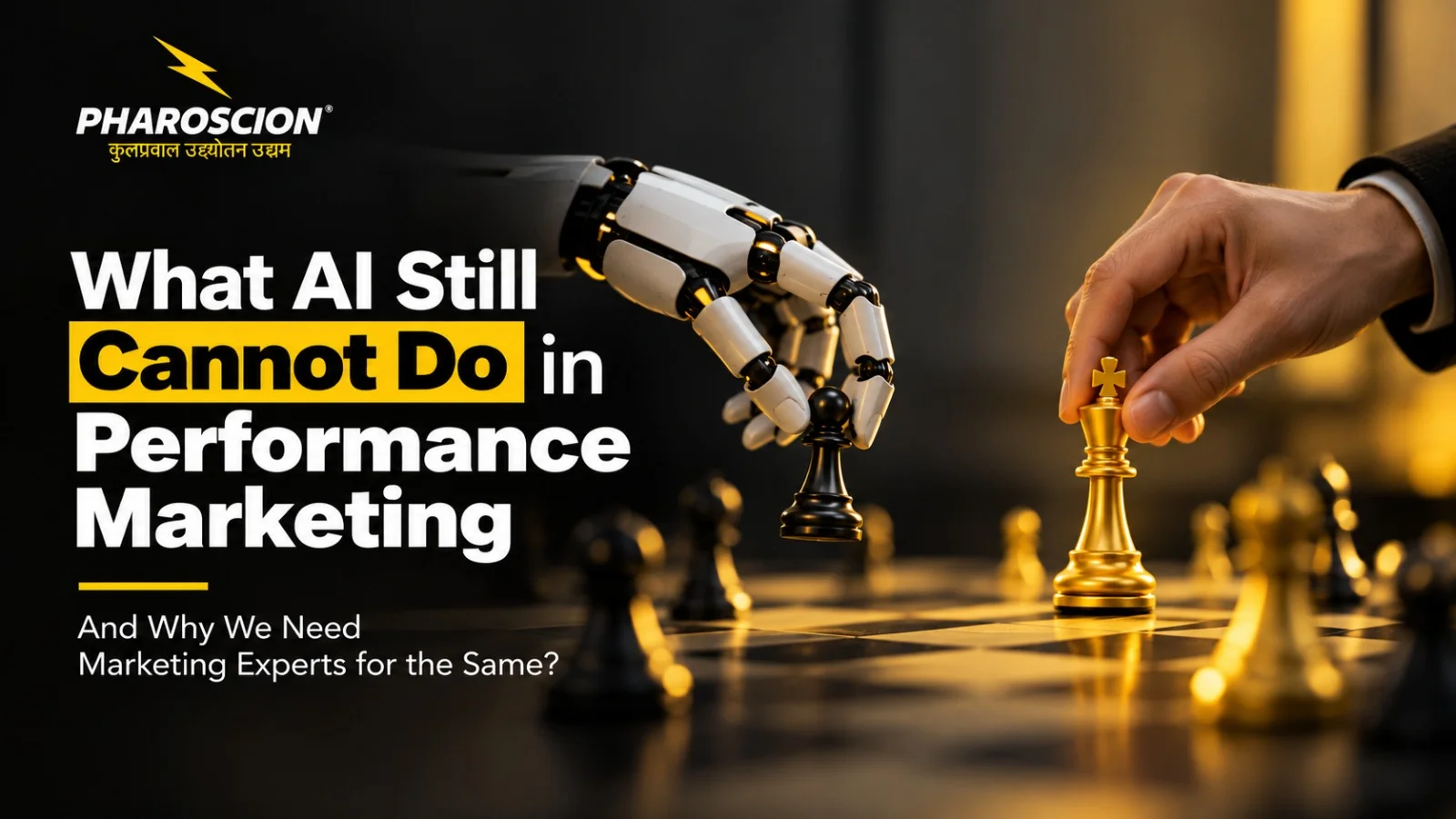
If AI can automate so much of performance marketing,
where does the marketing expert fit in?
The answer is
not about choosing between AI and marketers.
It is about
understanding which parts of performance marketing AI can improve, and where
human expertise remains essential.
From Manual Campaign Management to AI-Assisted Marketing
Traditional
performance marketing involved marketers manually managing audiences, bids,
keywords, budgets, creatives, placements, and campaign structures.
AI has changed
much of this process.
Platforms can now
automate bidding, identify audience patterns, recommend optimizations, generate
variations of creative content, and allocate budgets based on performance
signals.
This can
significantly reduce repetitive work.
But performance
marketing is not simply about making campaigns run.
The real
challenge is deciding what the campaign
should achieve, who it should reach, what message it should communicate, and
how it connects to the broader business objective.
That is where
the marketer's role becomes increasingly important.
AI Can Analyse Data. But Can It Understand the Business?
AI can process
enormous amounts of campaign data.
It can identify
that one audience has a lower cost per lead. It can detect that a particular
creative is receiving more engagement. It can recognize changes in conversion
rates and suggest budget adjustments.
But numbers do
not exist in isolation.
A campaign can
generate inexpensive leads while producing poor-quality prospects.
Another
campaign may have a higher cost per acquisition but bring customers with
significantly higher lifetime value.
An AI system
can identify the performance difference.
A marketing
expert needs to understand why that
difference matters to the business.
This requires
knowledge of the company's customers, sales process, margins, positioning,
market conditions, and business priorities.
AI Can Generate Creatives. But Strategy Still Comes First
Generative AI
can create headlines, ad copies, images, videos, and multiple creative
variations within minutes.
This makes creative
production faster.
But producing
more creatives does not automatically mean producing better advertising.
A marketing
expert still needs to determine:
·
What problem should the
campaign communicate?
·
What does the audience actually
care about?
·
What makes the brand different?
·
What tone should the brand use?
·
Which message is appropriate
for each stage of the customer journey?
·
What should the audience do
after seeing the advertisement?
AI Can Optimise Campaigns. But It Cannot Replace Context
Performance
platforms are becoming increasingly automated.
Campaign
systems can adjust bids, allocate budgets, identify conversion patterns, and
optimize delivery based on available signals.
However,
algorithms operate within the information and objectives they receive.
Consider a
company launching a new product.
An AI system
may see limited conversion data during the initial campaign period and
recommend reducing spend because acquisition costs are high.
A marketing
expert may understand that the company is intentionally investing in awareness,
entering a new market, or building demand before a major product launch.
The same data
can therefore lead to different decisions depending on the business context.
This is where having the right marketing
support matters. Learn more about ourServices.
AI sees the signals. Marketing experts understand the
situation behind them.
AI Can Identify Patterns. Humans Still Need to Ask the
Right Questions
One of the most
valuable skills in performance marketing is not simply analysing data.
It is asking
the right questions.
Why are
conversions declining?
Is the problem
the advertisement?
The landing
page?
The audience?
The offer?
The sales team?
The pricing?
The market?
The tracking setup?
AI can help
investigate these possibilities, but marketers still need to frame the problem
correctly.
If the wrong
question is being asked, even highly advanced AI can produce an efficient
answer to the wrong problem.
That is why
strategic thinking remains central to performance marketing.
AI Does Not Experience the Customer
Performance
marketing ultimately depends on understanding people.
Customers do
not always behave according to predictable data patterns.
Their decisions
can be influenced by trust, emotions, social proof, timing, personal
experiences, cultural factors, brand perception, and changing market
conditions.
A marketing
expert can combine quantitative campaign data with qualitative understanding of
the customer.
They can speak
to sales teams, study customer feedback, understand objections, review
competitor positioning, and identify changes in customer behaviour.
This human
context can influence the strategy behind the campaigns.
See how strategy, technology and marketing
come together in real business situations through ourCase
Studies.
The Marketing Expert's Role Is Changing, Not Disappearing
As AI takes
over more repetitive campaign-management tasks, marketers may spend less time
manually adjusting bids or creating dozens of variations.
Instead, their
role can increasingly focus on:
·
Marketing strategy
·
Customer understanding
·
Positioning
·
Offer development
·
Creative direction
·
Campaign architecture
·
Budget decisions
·
Data interpretation
·
Experiment design
·
Cross-channel planning
·
Business alignment
AI Needs Guardrails in Performance Marketing
The more
automated advertising becomes, the more important oversight becomes.
Marketing teams
need to establish clear guidelines around:
·
Budget allocation
·
Brand messaging
·
Customer data
·
Tracking and attribution
·
Creative approvals
·
Audience targeting
·
Testing frameworks
·
Campaign objectives
·
Performance benchmarks
Where AI and Marketing Experts Work Best Together
The strongest
performance marketing workflows are not built around AI replacing marketers.
They are built
around AI improving what marketers can
do.
AI can help
marketers:
·
Analyse campaign data faster
·
Generate creative variations
·
Identify performance patterns
·
Automate repetitive tasks
·
Support audience research
·
Assist with reporting
·
Speed up experimentation
·
Surface optimisation
opportunities
Marketing
experts can then focus on:
·
Defining the strategy
·
Understanding customers
·
Interpreting the data
·
Making business decisions
·
Developing the offer
·
Setting creative direction
·
Challenging assumptions
·
Connecting marketing activity
with revenue
This creates a
more effective division of responsibilities.
The Future Is Not AI vs Marketing Experts. It Is
Marketing Experts With Better AI.
AI is changing
performance marketing, but automation does not remove the need for expertise.
The competitive
advantage will increasingly come from knowing where AI should be used, where human judgement should remain central,
and how both can work together.
The objective
should not be to let AI run every campaign independently.
It should be to
give marketing teams better tools to analyse, experiment, execute, and learn
faster.
The future of
performance marketing may not belong to businesses that simply use the most AI.
It may belong
to businesses that know how to combine
AI capabilities with strong marketing thinking.
At Pharoscion,
we see AI as an opportunity to rethink how performance marketing teams work
rather than simply adding another tool to the marketing stack.
AI can accelerate
execution.
Marketing experts provide the direction.
And when both
work together, performance marketing can become not just more automated, but
more strategic, relevant, and connected to real business outcomes.
If you would like to discuss how this
approach could work for your business,Contact.
White
Papers: https://www.pharoscionglobal.com/white-papers
Blogs:
https://www.pharoscionglobal.com/blogs
Explore
Pharoscion: Products
| Services
| Contact
| Case
Studies